ORIGIN: Hindu (Vedic, Epic and Puranic)
TYPE: Mother goddess and goddess of wisdom. Later, patron of the arts.
KNOWN PERIOD OF WORSHIP: Circa 600 BCE, but undoubtedly based on a much earlier prehistoric model, until present.
SYNONYMS: Brahmi; Vagdevi (goddess of speech). Other epithets include Bharati.
CENTER(S) OF CULT: Throughout India
ART REFERENCES: Sculptures generally in bronze, but also in stone, reliefs.
LITERARY SOURCES: Rg Veda and other Vedic texts; Ramayana epic, and Puranic texts.
INFORMATION: Sarasvati, as an identifiable personality, may have begun as a Vedic river goddess (the actual river Sarasvati has now disappeared but she may also be linked with the Indus, etc.) In the Vedic capacity her waves are said to smash mountains and her voice is the roar of the torrent. Since her source of strength is the primeval water, she is inexhaustible and she is a bringer of fertility and bountiful harvests. Thus, by inference, she also provides prosperity. Her presence purifies and, in antiquity, she slew Vrtra, the demonic god of chaos. In her capacity as a Vedic goddess she is invoked on the sacrificial field with the lesser goddesses Ila, Bharati, Mahi, and Hotra.
In later Puranic literature Sarasvati (Brahmi) becomes the first consort of the creator god Brahma (See also Gayatri). Other texts offer her in contention with Laksmi as consort of Visnu. She also became syncretized with the goddess Vac. She is said to have invented Sanskrit and is identified as goddess of wisdom and of the arts. The Vedas are her inspiration and she may be known as the "mother of the Vedas". A Hindu festival in her honor is celebrated in early January or late February. She is a patron goddess of students, and books, pencils and pens are offered to her by children before they begin classes. Her image often appears on the portals of school gates.
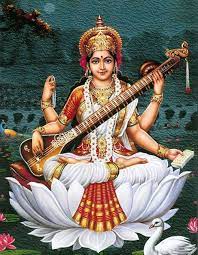
She is generally depicted with either two or four arms. She may be seated or ride upon a swan or a peacock or a lotus.
COLOR: White.
ATTRIBUTES: particularly the lute, but also arrow, bell, book, bow, conch, club, hook, prayer wheel, rosary, water jar and other items. She may offer a piece of sugar cane or a flower to Brahma. Infrequently three-headed.